Snap-lock panels lock together under foot or hand pressure and need no seamer; mechanical-seam panels are folded closed with a hand or power seamer, once to 90 degrees for a single lock or twice to 180 degrees for a double lock. Snap-lock installs faster and is the usual choice on residential roofs at moderate slopes. Mechanical seam costs more labor but is the system specified for low slopes and demanding commercial work. For a roll former owner, the choice comes down to which profile tooling the machine carries, which seamers you own or rent, and the slopes and specifications you bid.
How each seam works
Both systems hide the fasteners: a clip is screwed to the deck and caught under the panel’s leg. On a snap-lock panel the female leg is formed so it snaps over the male leg and the clip, and the seam is finished the moment it engages. On a mechanical-seam panel the legs are left upright and a seamer rolls them together on the roof. New Tech Machinery describes the single lock as one fold to 90 degrees, with less labor and easier panel replacement, and the double lock as two folds to 180 degrees, stronger, best suited to low slopes and slower to install. Mechanically seaming the legs also stiffens the panel, which helps it resist wind. A third family, often called nail-strip, is a snap-lock panel with a slotted fastening flange along one edge instead of separate clips; NTM’s FF100 and FF150 are examples.
Minimum slope: what panel makers publish
Slope limits belong to a tested panel system, not to a seam type in general, so always follow the data for the exact profile. Still, the published figures show the pattern clearly.
| Panel (maker) | Seam | Leg height | Published minimum slope |
|---|---|---|---|
| Medallion-Lok (McElroy) | Snap-lock | 1-3/4 in | 3:12 |
| Series 1500 (Englert) | Snap-lock | 1-1/2 in | 3:12 |
| Snap-Clad (PAC-CLAD) | Snap-lock | 1-3/4 in | 2:12 to 3:12 depending on the document |
| PAC-150 (PAC-CLAD) | Single lock, 90 degrees | 1-1/2 in | As low as 1:12 |
| Maxima (McElroy) | Mechanical | 1-1/2, 2 or 3 in | 1:12, 1/2:12 and 1/4:12 |
| Tite-Loc Plus (PAC-CLAD) | Double lock, 180 degrees | 2 in | 1/2:12 |
| Series 1300 (Englert) | Mechanical | 1-1/2 in | 1/2:12 |
NTM’s general guidance matches: snap-lock is typically used at 3:12 and steeper unless the panel maker says otherwise, while mechanical seam works down to 2:12 and sometimes lower, usually with sealant in the seam below 2:12. Wind ratings are also assembly-specific; McElroy lists both its snap-lock Medallion-Lok and its mechanical Maxima with UL 580 Class 90 and ASTM E1592 testing, so do not assume a snap-lock panel cannot meet a wind spec, or that every mechanical panel does.
Profiles on common portable machines
New Tech Machinery is the most common brand on the used market, and its profile names tell you the seam type.
| NTM profile | Seam | Seam height | Machines |
|---|---|---|---|
| SS100, SS150 | Mechanical | 1 in, 1-1/2 in | SSR, SSH; SSQ versions on SSQ II and SSQ3 |
| SS450, SS450SL | Snap-lock | 1-1/2 in | SSR, SSH; SSQ versions on SSQ II and SSQ3 |
| FF100, FF150 | Snap-lock with slotted flange | 1 in, 1-1/2 in | SSR, SSH; FFQ versions on SSQ II and SSQ3 |
| SSQ550 | Snap-lock, structural | 1-1/2 in | SSQ II, SSQ3 |
| SSQ675 | Snap-lock | 1-3/4 in | SSQ II, SSQ3 |
| SSQ200, SSQ210A | Mechanical | 2 in | SSQ II, SSQ3 |
| TRQ250 | Mechanical, trapezoidal | 2-1/2 in | SSQ II, SSQ3 |
| SSQ275 | Snap-lock or mechanical | 2 in | SSQ II, SSQ3 |
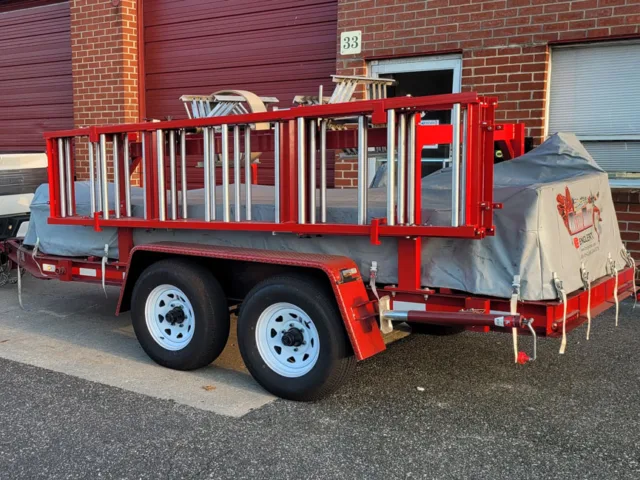
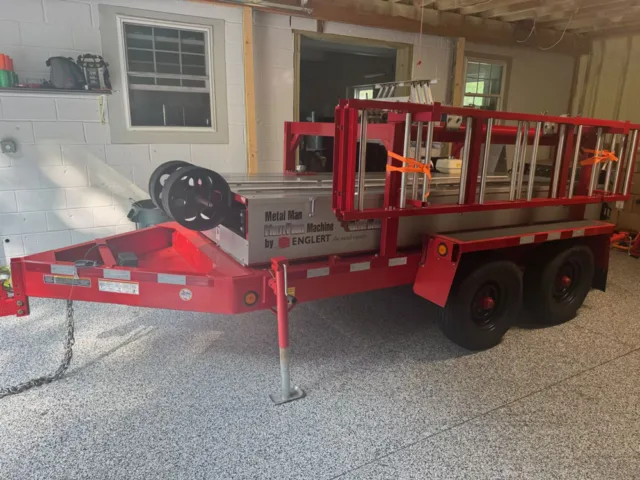
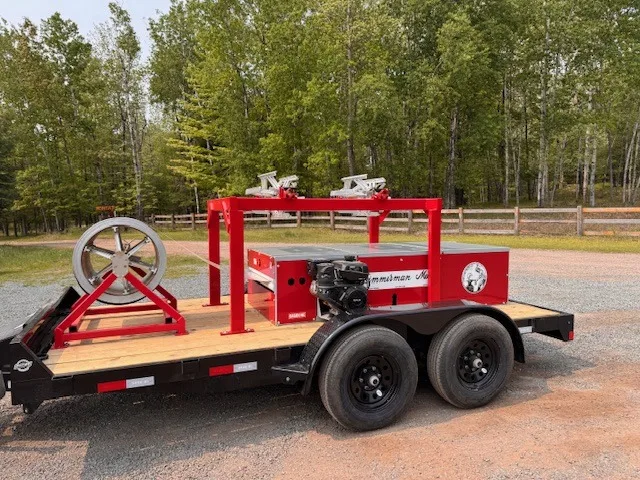
Zimmerman’s Z-Panel machine runs 1-inch nail-strip, 1 and 1-1/2 inch snap-lock and 1 and 1-1/2 inch standing seam profiles in 12 to 24 inch widths, and its Commercial machine adds a 1-3/4 inch snap-lock and 2 and 2-1/2 inch standing seam. Englert’s fixed-panel machines are built around one profile each, such as the 1-1/2 inch mechanically seamed FP1300 and the 1-1/2 inch snap-lock FP1500, while the MetalMan Multi-Panel switches between up to ten profiles.
The seamers you will need
Snap-lock needs only hand tools at the eave and ridge. Mechanical seam needs a hand seamer to start and finish each seam and a power seamer for the run. NTM notes that a power seamer gives a tighter seam than hand seaming. The seamer has to match the profile and seam height, and McElroy warns that using the wrong seamer on its panels can void the warranty, so ask the panel or coil supplier which tool is approved.
- Single and double lock. Some seamers close a double lock in one pass and convert to single lock with optional rolls, such as ESE’s K9 Double Lock, made for 1 and 1-1/2 inch seams. Others work in two stages: Englert’s ES-90 forms the 90-degree seam on its 1 and 1-1/2 inch panels and the ES-180 then closes it to 180 degrees, both at about 45 feet per minute.
- Buying. New power seamers checked in October 2026 ran $4,150 to $4,750 for the ESE K9 Double Lock depending on the seller, $4,200 for the K9 Single Lock, $5,250 for WUKO’s cordless Akku 0411 and about $7,000 to $7,750 for WUKO’s switchable Lok’n’Bak 0412. First-stage hand seamers start around $200.
- Renting. Panel suppliers and seamer rental companies rent profile-matched seamers by the day. Rates published by rental companies in 2026 run about $50 to $63 a day plus freight, sometimes with a hand crimper included. Renting makes sense until you seam most weeks.
Tooling sets and swapping on a used machine
On a multi-profile portable, each profile is a set of forming rollers with its own shear dies, and swapping sets is routine. NTM quotes 45 minutes or less with one person and one wrench on the SSQ II, about 25 minutes with the SSQ3’s QWIKSwap tooling, and about an hour on the SSR and SSH. Zimmerman quotes about an hour, and Englert says one person can change the Multi-Panel’s rollers in 30 minutes.
Profile sets are expensive, which is why they drive used prices. At NTM’s 2025 prices for the SSQ II a residential profile cost $10,600 and a commercial profile $21,200; for the SSQ3 in 2026 they are $11,600 and $23,300. NTM’s residential group includes the 1 and 1-1/2 inch seams, the SS450 snap-locks and the slotted-flange panels, while the 2 and 2-1/2 inch seams, SSQ550, SSQ675 and SSQ275 are commercial.
- Check that each set is complete: every forming station, the matching shear dies and any entry guides, labeled and free of rust and scoring. Run a test panel in each profile.
- Check fit between generations. NTM says the SSQ II and SSQ3 make the same 16 profiles, but it also notes some profiles may need specific tooling sets and QWIKSwap is not yet offered for every profile. Get written confirmation from the maker, by serial number, before buying SSQ II tooling for an SSQ3 or the reverse.
- Match the tooling to your work. A machine with only snap-lock sets cannot bid a 1/2:12 roof, and a machine with only 2-inch mechanical tooling makes every residential job a seamer job.
Choosing for your market
- Residential re-roofs at 3:12 and up: a 1-1/2 or 1-3/4 inch snap-lock profile and no seamer to buy.
- Low-slope and commercial work: a 2-inch mechanical profile and a double-lock seamer, owned or rented.
- Both from one set: a profile designed to be snap-locked or seamed, such as NTM’s SSQ275.
- Budget machine: an SSR or SSH with SS150 and SS450 tooling gives you one mechanical and one snap-lock residential profile.
Frequently asked questions
Can a snap-lock panel be mechanically seamed?
Only if the profile is designed for it. NTM’s SSQ275 can be snap-locked or seamed; a standard snap-lock profile is not formed to be rolled closed and should be installed as designed.
Do I need different seamers for single and double lock?
Sometimes. Some seamers do both by swapping rolls or flipping a lever, while others are separate first-stage and second-stage machines. Match the seamer to the profile and seam height your panel supplier specifies.
How long does it take to change profiles on a used roll former?
NTM quotes about 25 minutes on the SSQ3, 45 minutes or less on the SSQ II and about an hour on the SSR and SSH; Zimmerman quotes about an hour. A seller who will not demonstrate a changeover may be missing parts.
Browse used roll formers and used seamers, see New Tech Machinery and Zimmerman listings, or compare NTM machine classes in our SSQ II vs SSQ3 vs SSR vs SSH guide.