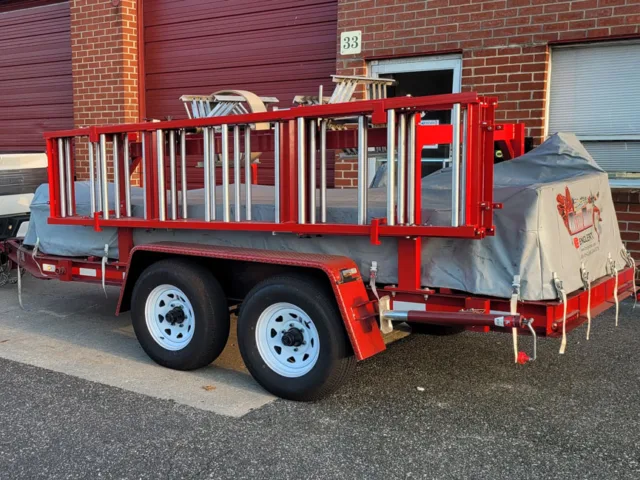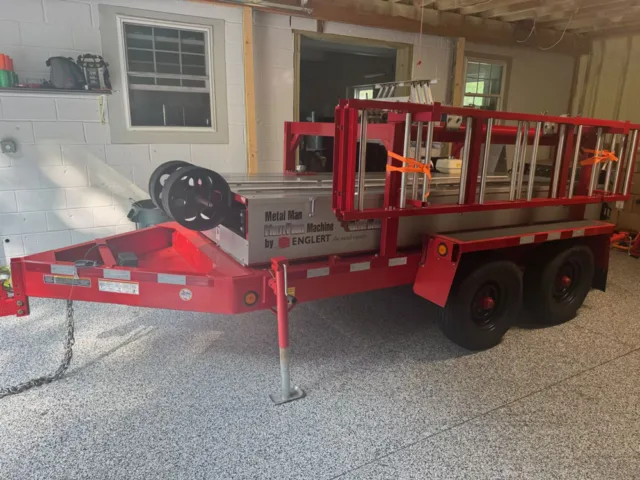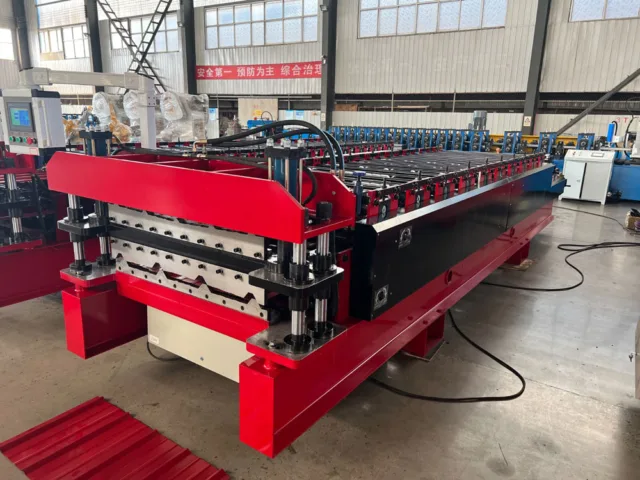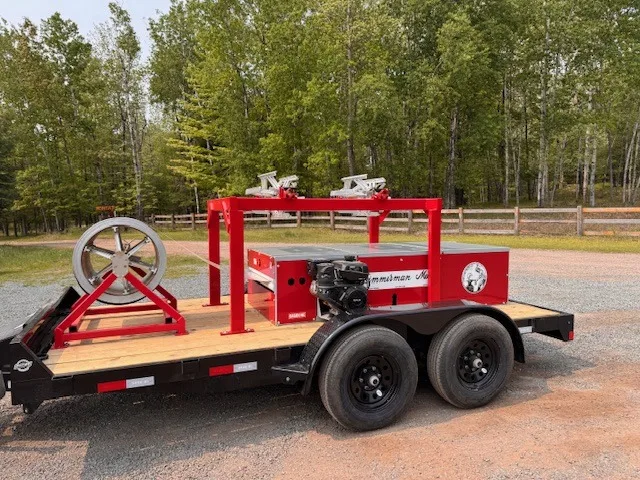
A used portable standing seam roll former costs anywhere from about $6,000 for an old stationary single-profile machine to $100,000 for a three-year-old New Tech Machinery SSQ II with tooling and a trailer. The two numbers that matter most are the machine class and what tooling comes with it. Below are the prices we verified from public listings and manufacturer price pages, and what moves a specific machine inside those ranges.
The short answer, by machine class
Every figure in this table comes from a source we checked in 2026: a manufacturer price page, a dealer listing or a public auction result. New prices are base or package prices before freight and tax. Used prices are asking or sold prices for specific machines, not a market index.
| Machine class (example) | New price (year checked) | Used prices we found | Notes |
|---|---|---|---|
| Hand-fed 1-inch portable (WUKO Master 0420S) | $46,900 to $52,000 (2026) | $39,900 for a 2025 unit with low hours | Single profile, 11-5/8 to 32 inch widths, 120 V or 230 V |
| Entry portable, electric drive (NTM SSR MultiPro Jr.) | $37,000 (2023) to $44,900+ (2026); trailer $19,650 extra | Used 2015 and 2017 units listed with trailer and cover, price on request | Manual shear, about 30 ft/min, 1,715 lb bare |
| Mid portable, hydraulic (NTM SSH MultiPro) | $52,000 (2023), $59,200 (2024), $71,600+ (2026) | Used 2023 unit with gas, reel rack, trailer listed in Texas, price on request | Hydraulic shear, about 60 ft/min, 4,620 lb on trailer |
| Full commercial portable (NTM SSQ II MultiPro) | $63,400 base with no profile; $74,000 to $84,600 with one profile; packages $78,600 to $161,900 (2025) | $85,000 (2022, with trailer, as-is); $99,500 (2022, maintained); $100,000 at auction March 2023 (3 die sets, 18 hours) | 16 profiles, 12 to 24 inch panels; discontinued Sept 30, 2026 |
| Current flagship (NTM SSQ3 MultiPro) | $66,600 to $68,900 base; packages $85,400 to $176,000 (2026) | None on the used market yet | Introduced October 2025; expect first used units in 2027 |
| Older in-plant single profile (Roll Former Corp VS-150) | No longer sold new | $6,380 at auction, August 2018 | Stationary, one profile, needs a forklift to move |
Price by machine class
Hand-fed and mini 1-inch machines
These are compact electric roll formers that run one profile, usually a 1-inch mechanical lock, and sit on a stand or in the back of a van. The WUKO Master is the common example; Schlebach minis and StanGroup’s SS4E Junior fill the same role. New prices sit in the high forties to low fifties, and the one used data point we have, a 2025 Master with low hours at $39,900, shows how little a nearly new machine drops. There is no trailer and no hydraulics, but also very little to break.
Entry-level portable machines with an electric drive
The NTM SSR MultiPro Jr. defines this class: seven profiles, 12 to 16 inch panels, a 1.5 HP 120 V motor, eight drive rollers and a manual shear. NTM’s published start price rose from $37,000 in 2023 to $44,900 in 2026, and the trailer is another $19,650. Used SSR machines come up a few times a year, usually eight to ten years old with the trailer, and sellers tend to quote by phone.
Mid-range hydraulic portables
The NTM SSH MultiPro adds a hydraulic drive and shear, a PLC batch and length controller and about 60 feet per minute, with the same seven profiles as the SSR but panels up to 20 inches. The base price moved from $52,000 to $71,600 between mid-2023 and 2026, which matters for used pricing: a 2021 SSH was bought for far less than it would cost to replace today, so sellers who price off replacement cost will ask more than sellers who price off what they paid.
Full commercial portables: SSQ II and SSQ3
This is where most of the money changes hands. The SSQ II ran 16 profiles across 12 to 24 inch widths with 16 drive rollers and a 75 feet per minute gas option. Under NTM’s 2025 pricing the bare machine with a power pack but no profile was $63,400, a residential profile added $10,600 and a commercial profile added $21,200, so a working machine was $74,000 to $84,600 before a trailer or an automatic controller. Complete packages ran $78,600 to $161,900.
Against that, the used prices we found are tight: $85,000 asked for a 2022 machine sold as-is with a 2022 flatbed trailer, $99,500 asked for a 2022 machine described as professionally maintained, and $100,000 paid at a March 2023 auction for a machine with three sets of dies and 18 hours. NTM discontinued the SSQ II on September 30, 2026; the SSQ3 that replaced it starts at $66,600 to $68,900 bare and $85,400 to $176,000 in packages, so the ceiling for used SSQ IIs is set by those numbers, not by the old $76,000 figure.
In-plant and older stationary machines
Older single-profile stationary machines and small industrial roll formers sell for a fraction of the portable prices. A Roll Former Corporation VS-150 standing seam machine sold at auction for $6,380 in 2018, and a used-equipment marketplace reported generic small roll formers in California averaging about $2,650 in 2026. These machines need a forklift, floor space and often three-phase power, and parts for the oldest ones can be a project. They suit a shop that runs one profile all day and never leaves the building.
New versus used: what the gap really is
On paper a used SSQ II at $85,000 against a new SSQ3 package at $120,000 or more is a $35,000 saving. In practice the comparison has to be made line by line, because a new machine comes with a three-year parts and in-house labor warranty, the newest control, and the profile you choose, while the used machine comes with whatever the first owner bought. Add up what the used machine includes: each profile is worth $10,600 to $23,300 at new prices, the UNIQ controller $17,600 to $22,500, a trailer about $19,000, expandable arbors $2,800 a side and run-out tables roughly $950 a section. A used machine that includes two commercial profiles, the automatic controller and a trailer can be a bargain at a price that would look high for a bare machine.
Then subtract freight or a truck that can tow 5,000 to 6,500 lb, the inspection trip, any drive rollers or shear blades that are due, and the risk of buying without a warranty. Our inspection checklist covers what to look at.
Price by age
We do not have enough public sales of 8 to 15 year old machines to publish a clean depreciation curve, and anyone who shows you one should be asked where the data came from. What the verified points show is this: a one-year-old hand-fed machine sold for about 80 percent of its new price, and three to four year old SSQ IIs with tooling have asked 75 to 95 percent of what an equivalent new machine cost at the time of purchase. Age alone does not move these machines much; hours, tooling and whether the model is still supported do.
What drives the price up or down
- Profiles and tooling. The biggest single factor. Count the profile sets, rib rollers and shear dies, and price each against the maker’s current list.
- Controller. A manual control, a PLC batch and length control, or a full automatic system such as NTM’s UNIQ. The automatic systems add $17,000 or more new.
- Power pack. Gas is the most flexible for job sites; electric packs tie you to 220 V single or three-phase power. NTM’s Quick-Change pack lets a machine swap between them, and a second pack lists at about $9,300.
- Trailer. A factory trailer is $19,000 to $19,650 new. A used machine on a titled, braked trailer is worth more than one sitting on blocks.
- Notching and angled slitting. Notching packages add tens of thousands new and require the automatic controller; they only matter if you run commercial panels that need it.
- Hours and condition. Polyurethane drive rollers, forming rollers, hydraulic pump and shear blades are the wear items. A machine with 18 hours sold for $100,000; one with 2,000 hours will not.
- Model support. The SSQ II is discontinued, which does not end parts supply but does change the resale story. Ask the maker before you buy any model that is no longer built.
- Location and freight. Towing is cheap; a flatbed move across two states is not.
- Paperwork. Invoice, manuals, service records and a clean trailer title make a machine easier to finance and resell.
How to use these numbers when you make an offer
Start from the maker’s current price for an equivalent new machine with the same profiles, controller and trailer, because that is the seller’s ceiling and your alternative. Subtract the warranty you will not get and the money you will spend on freight and the inspection trip. Then look hard at the wear items and the hour meter and take off the cost of anything due. Every machine listed on this site shows the asking price, year, location, power and tooling so you can run that math before you call. Browse used roll formers, or go straight to New Tech Machinery, Englert and Zimmerman listings. If you need to spread the cost, our equipment financing page explains what lenders currently offer on used machinery.
Frequently asked questions
Is a used SSQ II still a good buy now that it is discontinued?
Yes, if the price reflects it. The machine, profiles and controller do not change because the model stopped shipping, and NTM has a large installed base to support. What changes is the ceiling: a used SSQ II should now be priced against a new SSQ3 at $66,600 to $68,900 bare, not against the old $76,000 figure, and you should confirm parts availability for the controller generation on the machine.
Why do used NTM machines cost almost as much as new?
Because the profiles, controller and trailer that were extras on the new invoice come with the used machine, and because NTM raised base prices by roughly 20 to 35 percent between 2023 and 2026. A 2022 machine that cost $110,000 complete is being compared with a new equivalent closer to $140,000, so an asking price in the nineties is not out of line.
Can I finance a used roll former?
Yes. Lenders finance used equipment that has an established resale market, typically at 8 to 18 percent APR over two to five years with 10 to 25 percent down, and SBA 7(a) loans can run up to ten years. You will need a written quote or invoice from the seller, which is one reason to buy from a listing that states a real price. See our financing page.